

Acuity Training vs Happy – Best Excel Training Provider in 2026
This is our guide to Acuity Training and Happy’s Excel courses in London. We took a careful look at the accreditation, trainer quality, course structure, pricing and support options for each provider.
Our goal is to help professionals in the area choose the best provider for their Excel training in 2026.
How You Should Choose A Training Provider For You / Your Team
To start off let’s split off the first main factor. When you choose Excel training provider for a team, you have to take different things into account from choosing a course for an individual.
The goal with team training isn’t just explaining features one by one. Good corporate training improves confidence, consistency and real-world capability for the whole group.
For many professionals and organisations alike, this comes down to a companies credibility, track record and long-term value.
Acuity Training and Happy are both established names in Excel Training for London, but their programmes do come with a few key differences! Acuity Training builds up structured, focused learning with verified accreditation, Happy on the other hand has a broader catalogue with some very generous long-term support.
We’re a training company first and foremost, and we want to see people satisfied with the outcomes of their courses – no matter who they end up picking!
That’s why we researched and wrote this comparison around five key areas that matters most when it comes to training. If you want to know more, have a look at our methodology to see how we went about it!
A Quick Summary Of Our Research
| Category | Acuity Training | Happy | Key Difference |
| Accreditation | Microsoft Partner and CPD accredited; | CPD accredited; no Microsoft accreditation | Acuity is Microsoft-accredited |
| Instructor Quality | Named & qualified trainers with video introductions | Trainer videos with fewer background details | Acuity focuses on instructor visibility. |
| Course Structure | Five courses and structured levels: Beginner, Intermediate, Advanced – a linear learning path. | Eleven Excel courses across mixed topics – modular, pick-and-mix. | Acuity follows a guided pathway; Happy offers modular flexibility. |
| Pricing | Starts at £285 per day; in-person and online options. | Starts at £315 per day; in-person and online options. | Happy is slightly more expensive per session. |
| Scheduling & Cancellation | Refund if cancelled more than 14 days before the course | Refund if cancelled more than 28 days before the course | Acuity offers more lenient cancellations. |
| Post-Course Support | 6 months of direct trainer support for practical follow-up. | 2 years of IT helpline access for general support. | Acuity = shorter but more personal; Happy = longer but less direct. |
| Best For | Professionals and corporate teams seeking accredited, structured, high-contact training. | Learners who prefer topic-based workshops and long-term reassurance. | Acuity suits structured corporate learning; Happy suits exploratory learners. |
Summary of Key Findings:
- Acuity Training is a Microsoft Partner with 20+ years’ experience.
- Happy offers a broader, modular course selection but less structure.
- Acuity provides smaller class sizes and more instructor visibility.
- Pricing is similar, but Acuity’s cancellation policy is more flexible.
- Acuity focuses on professional skill-building; Happy suits casual learners.

Who This Comparison Is For
We built this comparison for professionals and teams (not just one or the other!) that are looking to invest in high quality Excel training that can really deliver. It’s a great solution for:
- Choosing between different types of training (structured / instructor led training vs flexible workshops)
- Comparing the different support models that are often buried out of sight
- Finally getting a solid answer on what’s best for your team, or your individual professional development
1. Accreditation, Trust & Proven Background
Acuity Training comes with over 20 years of Microsoft Partner experience, which is a big deal. It’s a recognised and approved provider, and has been for a long time. It also has CPD accreditation, and over 1500 Feefo reviews going back to 2013, which really helps give their learners confidence in them. Think of it like picking a University, one with a great track record for 20 years is going to be high up on your list.
Happy also holds that CPD accreditation, and has a very healthy review profile. However, their 2300+ Feefo reviews begins in 2017, which means their track record is shorter. Happy does not hold Microsoft accreditation, which may not matter for informal learners, but can be very important for companies that need training aligned with recognised standards and internal compliance requirements.
For teams choosing a training provider, this distinction matters. Corporate training often prioritises proven delivery, recognised accreditation, and long-term credibility over novelty and flexibility alone. While both providers are experienced, Acuity Training’s Microsoft Partnership and longer review history make it the more established and solid option for organisations that need training they can have confidence in.
2. Instructor Quality & Learning Experience
Acuity Training highlights its trainers as a central part of the learning experience, with named instructors for each course, with background info on their qualifications. This transparency gives learners confidence in who is leading their session and what expertise they bring. Courses are capped at just six delegates per session, creating a friendly environment where people get plenty of time with their trainers.
Happy also presents its trainers via video, but instructor names, qualifications, and professional backgrounds are less explicitly mentioned. Happy’s Excel classes run with around eight delegates, which is still a small and manageable group size – but offers slightly less one-to-one interaction per learner compared to Acuity Training.
For learners who value trainer access and personalised teaching – especially those attending Excel training to solve real workplace tasks – Acuity Training’s smaller class model and emphasis on instructor credibility make for a more focused and personal learning environment, while Happy offers a friendly but less instructor-centric format.
3. Course Structure & Learning Path Design
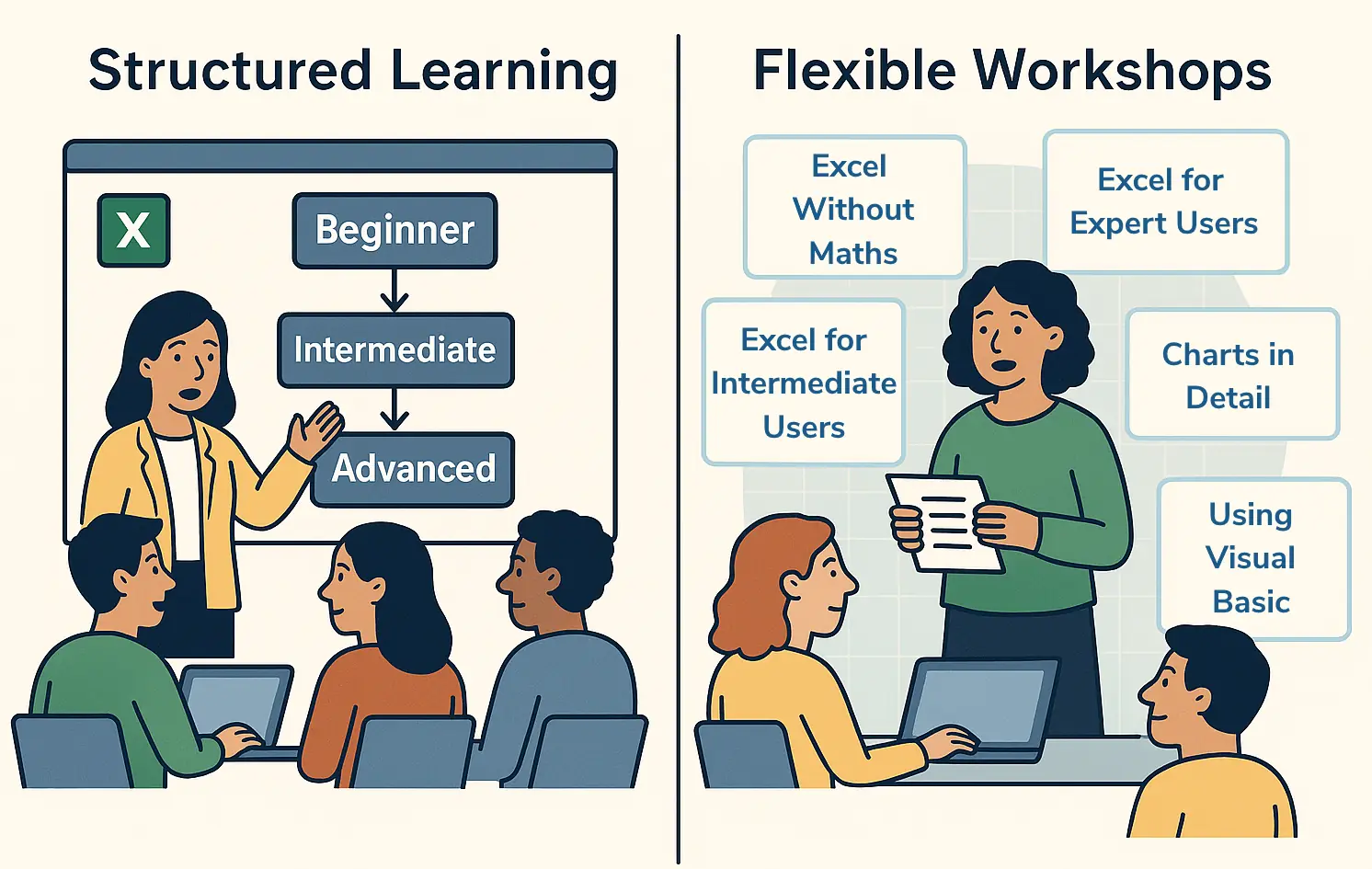
Acuity Training offers five structured Excel courses, designed to guide learners clearly from beginner level, through intermediate and all the way to advanced. The pathway is easy to follow and built around skill progression rather than course volume, allowing learners or teams to build on their Excel skills efficiently.
Happy, by contrast, offers 11 Excel-related courses, including several niche topic sessions and alternate formats. This wide catalogue suits learners who like to browse a variety of options or mix and match topics. However, the learning journey is less linear and more reliant on the learner knowing exactly what they want to pick next, making it better suited for people that prefer variety to structured progression.
In practical terms, Acuity feels more like a professionally mapped Excel learning journey, while Happy takes a more pick-and-mix approach. Both have value – but for learners and teams who want a clear roadmap, Acuity Training offers a more purpose-built path
4. Pricing, Scheduling & Business Flexibility
Acuity Training sits in the mid-range pricing category, with courses starting at £275 per day, for introductory Excel training both online and at their offices in Central London. It allows cancellations up to 14 days before the course and has a strong reputation for not cancelling scheduled sessions, providing some flexibility for those unavoidable cancellations.
Happy also operates in the same pricing range, with courses starting at £315 per day for their 90-minute virtual workshops. They also run in Central London location. Their cancellation policy, however, requires 28 days’ notice, which is a little more rigid and less flexible.
While pricing & location is similar, Acuity Training’s shorter cancellation window offers more scheduling confidence, making it a better fit for corporations looking to train up their departments.
5. Post-Course Support & Long-Term Value
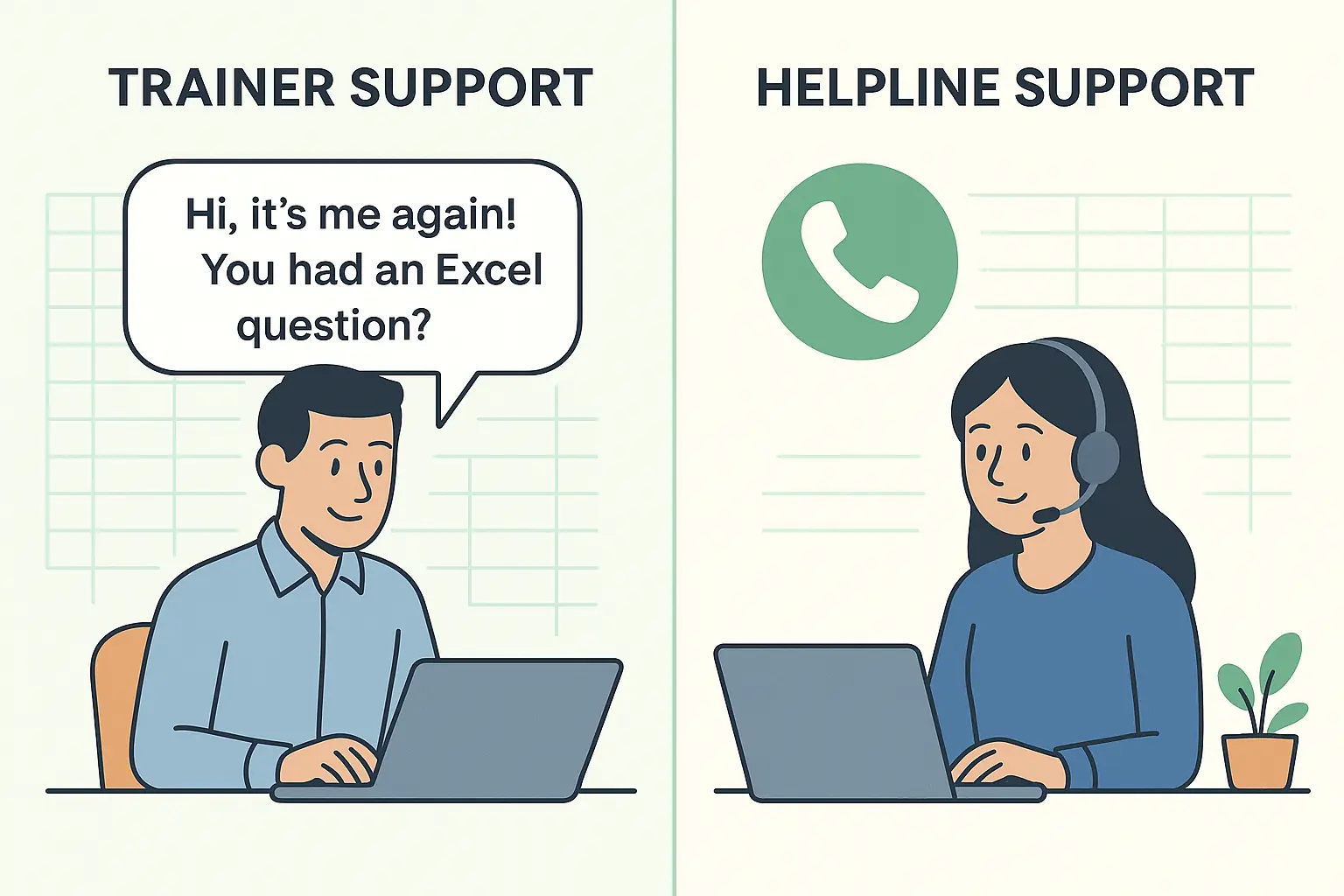
Acuity Training provides six months of post-course support with direct access to the trainer who actually delivered your course. This model is very practical – learners can apply their Excel skills at work and still reach back to an expert instructor when questions arise. For many delegates, this hands-on, instructor-led support period is where the real learning sticks.
Happy offers two years of ongoing support access through their IT Helpline. This is open to any Excel questions relating to course content. While the duration is longer, the model functions more like a broad support guarantee, making it reassuring for learners who prefer knowing help is available over time, even if not directly tied to the original trainer.
The main difference is simple: Acuity Training focuses on expert guidance when it matters most – while learners are actively applying new Excel skills, whereas Happy offers a longer safety net for those who like knowing help is there in the background. So, if you want direct, expert feedback: Acuity Training’s approach delivers more meaningful value. If long-term reassurance matters more than depth, Happy’s extended helpline support may be appealing.
Conclusion – Acuity Training vs Happy
Both Acuity Training and Happy deliver Excel courses that will teach you the software, but the learning experiences and outcomes are different depending on what you value.
Happy takes a broad, accessible approach, offering a wide menu of Excel workshops and extended reassurance through long-term support. It’s well-suited to learners who like to browse topics, dip in and out of training over time, and are comfortable with a more general, workshop-style environment.
Acuity Training takes a more focused, professional approach to Excel. Rather than offering just variety, it emphasises accredited structures, small-cohort delivery, trainer visibility and high-contact learning. This approach is designed not just to teach Excel, but to grow confidence and practical ability quickly, especially for people who will use Excel in a business setting.
If your aim is just to attend a course and explore different Excel topics, Happy offers plenty of choice. But if you’re looking for training that feels more intentional, where the goal is not just to attend, but to leave feeling capable and confident using Excel professionally, Acuity Training provides a more structured and impactful learning experience.
In short, Acuity Training offers structured, accredited, professional Excel courses, while Happy provides flexible, accessible workshops – each serving different learner goals.
FAQ: Acuity Training vs Happy for Excel Courses (2025)
Q: Which Excel training provider is better for professional development?
A: Acuity Training is the stronger choice for professionals who want structured, accredited courses with hands-on instruction. Its Microsoft Partnership and small group sizes make it ideal for business-focused learners.
Q: Is Happy good for casual or individual learners?
A: Yes. Happy’s flexible, topic-based Excel workshops suit learners who prefer to dip into specific areas or take shorter, less formal sessions.
Q: What makes Acuity Training stand out?
A: Acuity Training combines Microsoft Partnership, small class sizes, and direct trainer support. This approach helps learners apply Excel skills confidently in real workplace settings.
Q: How do post-course support options differ?
A: Acuity Training offers six months of direct access to the same trainer who led your course, providing targeted help. Happy provides two years of helpline access, which is broader but less personalized.
Q: Which is more flexible with scheduling and cancellations?
A: Acuity Training offers more flexibility, with a 14-day cancellation window and a reputation for running all scheduled sessions reliably.
Q: Which provider offers better long-term value?
A: For corporate teams and professionals, Acuity Training’s structured pathway and accredited trainers deliver stronger long-term skills value. Happy’s extended helpline may appeal to those wanting ongoing reassurance rather than intensive instruction.
Q: Who should choose Happy.com over Acuity Training?
A: Learners who prefer shorter workshops, self-directed topic selection, and a relaxed learning pace may find Happy more suitable. However, those seeking measurable skill improvement and professional recognition should choose Acuity Training.
Methodology – How This Comparison Was Conducted
Each provider was evaluated using five key criteria that matter most for professionals investing in Excel training:
1. Accreditation and Credibility: Verified through official listings such as Microsoft Partner and CPD certification databases, plus review platforms including Feefo and Trustpilot.
2. Instructor Quality and Learning Experience: Assessed based on trainer visibility, class size, and how each provider presents instructor credentials & learning formats on their official websites.
3. Course Structure and Learning Path Design: Measured by clarity of progression (beginner to advanced), skill-building efficiency, and ease of understanding for corporate learners.
4. Pricing, Scheduling and Flexibility: Compared via publicly listed course costs, duration, cancellation policies, and delivery options (in-person vs online).
5. Post-Course Support and Long-Term Value: Evaluated based on the length and depth of learner support after completion, and what that support specifically includes.
All data was cross-checked using each company’s official website, current course listings, and publicly verified accreditation records. Research done on 15th October 2025.

- Facebook: https://www.facebook.com/profile.php?id=100066814899655
- X (Twitter): https://twitter.com/AcuityTraining
- LinkedIn: https://www.linkedin.com/company/acuity-training/