

How to Handle Remote Working Requests (or Flexi Time)
Contents
Managing any team is usually challenging. Your role is to bring the best out of every team member, allowing them to be productive and happy. Doing that for multiple people is difficult. The larger the team, the harder it gets.
Now consider how many team members are working remotely or would like to.
According to Statista, in April 2020, roughly 50% of UK workers were working from home. By May 2023 (Post-COVID), this figure had dropped to 31%
As a manager, it’s highly likely that a member of staff will ask about remote working or flextime.
You need to know how to handle the request.
Know The Law
All UK employees are entitled to request remote or flexible working twice a year.
You must give an answer within two months. You must be fair, and you must provide a genuine reason for turning down any request.
We recommend you document every step of the process to protect yourself and your business.

1 – Respond Immediately
Something we teach on our Line Manager training in London is regardless of what your final answer will be, you need to respond as quickly as possible. Ideally, within a couple of business days maximum.
You should simply state you have received their request, will consider it thoroughly, and give them a reply within two months.
You can suggest a meeting date to discuss your decision, or you can set this later.
2 – Considering The Request
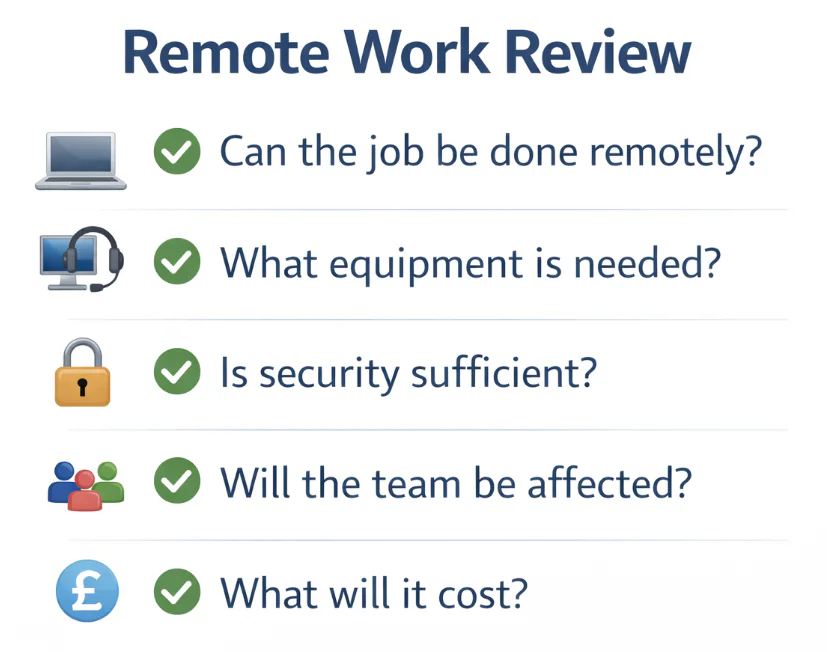
It’s vital that you document every stage of your review process. Consider the following:
Can the employee easily and effectively work from home?
An employee who spends all day at a computer processing information can work from anywhere. One who deals with customers face-to-face may find it difficult to work from home.
The latter may be eligible for flextime as they will still be present for customers, just at different hours.
What equipment will be needed?
For an employee to work from home, they’ll need a computer, fast internet, and a dedicated workspace. They’ll also need company software or cloud access.
It’s likely the company will need to supply relevant equipment. Can the business afford to do this? Remember, it’s not just about one person. If you approve them, how many others are likely to ask?
Is security up to standard?
Remote employees must have secure access to company data and have adequate virus and malware protection on their devices. Are you in a position to install this?
It’s more than just having the right finances. You need the right IT specialist to ensure data security.
How will the in-house team be affected?
Next, consider the team that the employee works within. If the request is granted, will it increase the workload for those in the office? Managing hybrid and remote teams is a very different challenge!
Is remote working likely to affect customer service and satisfaction?
You should also consider whether it would affect team morale. The team may not function as well with a person missing: it changes the dynamics.
Are there any alternatives?
It’s important to consider why an employee wants to work from home or on flexi-time. It will help you decide if there is an alternative that works better.
For example, an employee is struggling with childcare and wants to work from home two days a week to avoid the need for childcare. You feel this will reduce productivity, but so will saying no, as the employee is likely to have more time off.
Consider an alternative, like arranging or paying for child care for them close to the office. If your business is big enough, you could even offer childcare to all staff.
3 – Arrange A Meeting
Having done your preliminary research, you need to talk to the employee requesting remote working. It’s a legal requirement to consult with them before refusing a request.
More importantly, having a meeting shows you are taking the request seriously. It also gives you all the facts. If your employee doesn’t feel like you are listening, then they aren’t likely to stick around – more on this in our why employees quit statistics.
Start the meeting by acknowledging their request. Then, explain your concerns. You don’t need to tell them if you are allowing their request or not.
Encourage them to respond to your concerns and present their argument as to why they should be allowed to complete remote work. They should also share why they think it will be effective.
Discuss any alternatives. It’s generally easier to think of alternatives when you have all the facts.
Ask as many questions as possible. The more information you have, the easier it is to make and justify a decision.
4 – Decision Time
Between the meeting and the end of two months from the date of the request, you need to make a decision.
Consider all the information and decide if you are going to grant the request or not.
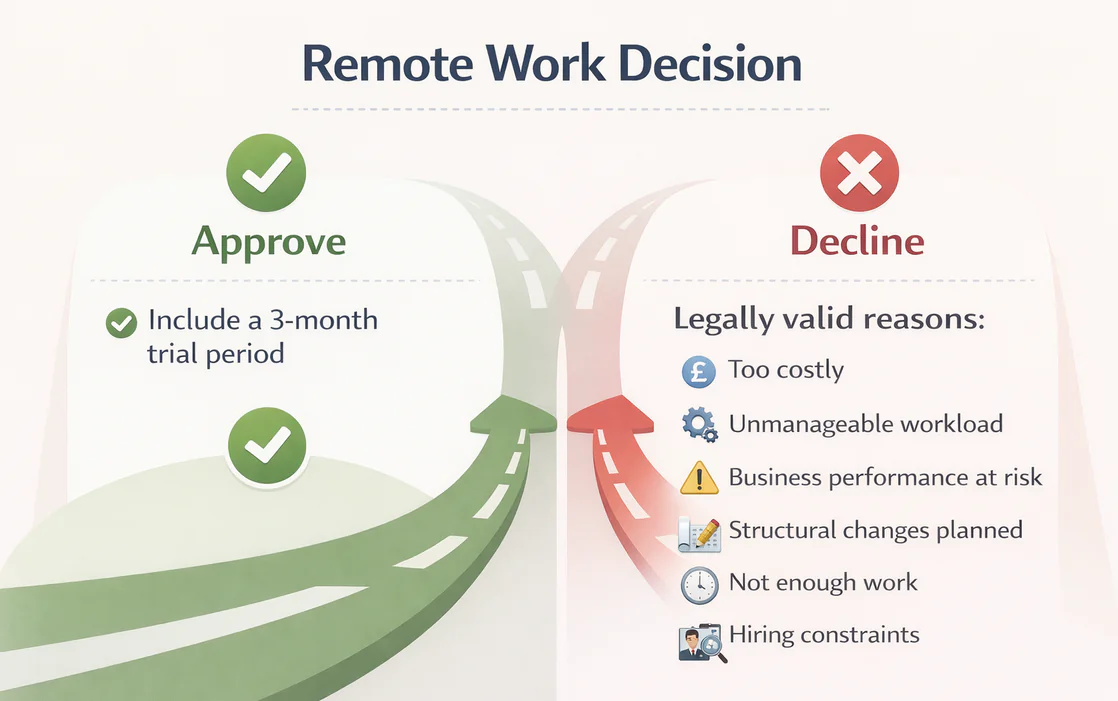
Remember, if the answer is no, it must be for one of the following reasons:
- The additional costs are too much for the business at this time
- It’s impossible to change the workload to make the request achievable
- You believe it will have a detrimental effect on quality, performance, or your business’s ability to meet customer demand
- You’re planning structural changes to the business, and remote working doesn’t fit the new model
- There’s not enough work to justify the work schedule your employee proposed
- You’re struggling to recruit additional staff, which would make remote work feasible
Provided you have a valid reason, which fits into one of the above categories, you can say no to your employee.
5 – Write Your Response
It’s best to write to your employee with your decision. This gives them time to digest the news and react calmly.
Make sure you state whether you are agreeing to their request or not.
If you aren’t allowing the remote working request:
State why their remote working request isn’t feasible at this time. The more reasons you give, the easier it is for your staff member to accept the decision. Be as detailed as possible.
If you are proposing an alternative, outline the details and ask them if they are prepared to accept this instead.
Alternatively, you can suggest that things may change, and the request can be resubmitted in six months.
If you’re allowing the remote working request:
Specify exactly what you are agreeing to and when the remote working will start. You’ll need to adjust their contract accordingly.
It’s also vital that you tell your employee there is a trial period. Three months is normal. This gives you and your employee time to see how it works and whether it is the right decision for everyone involved.
Make sure you document the decision process and the final decision. It will show that you took the request seriously and treated it fairly.



- Facebook: https://www.facebook.com/profile.php?id=100066814899655
- X (Twitter): https://twitter.com/AcuityTraining
- LinkedIn: https://www.linkedin.com/company/acuity-training/