

How To Pick The Best Power BI Course In London
Contents
- 1 What People Usually Mean by “Best Power BI Course in London”
- 2 How to Judge Whether a Power BI Course Is Actually Worth Taking
- 3 Should You Prioritise PL-300 / Certification?
- 4 How to Research Power BI Training Providers Properly
- 5 Classroom vs Live Online Power BI Training
- 6 What Is a Reasonable Price for Power BI Training in London?
- 7 Final Takeaway
If you are looking for the “best Power BI course in London”, you’ll find loads of different businesses, all telling you that they are the one to trust.
However, there isn’t just one Power BI course that everyone should go on – it’s just not that simple sadly!
What works well for one person may be completely wrong for another. Choosing properly means thinking about a few key factors first:
-
Your current experience with Power BI
-
Whether the training is for you personally or for a wider team
-
Whether your priority is hands-on reporting or formal recognition
-
How quickly you need Power BI skills to translate into real work results
This guide exists for one reason:
to help you avoid booking a course that sounds right but doesn’t actually move the needle once you’re back at work.
What People Usually Mean by “Best Power BI Course in London”
When most people say “the best”, what they mean is “best for me”!
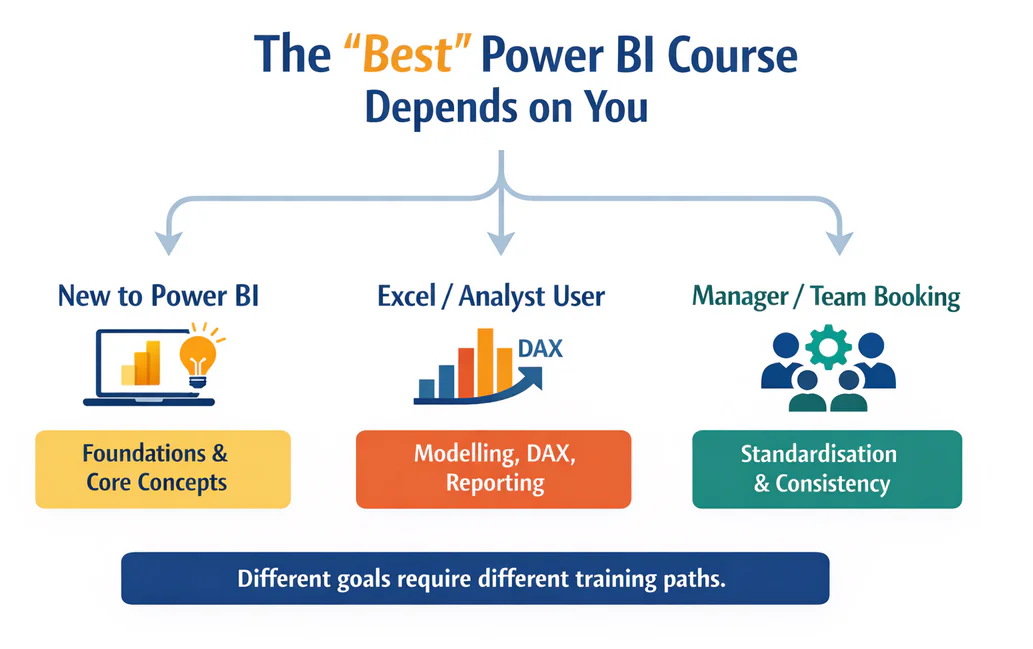
In practice, buyers usually fall into one of these categories:
-
New users who want Power BI to feel less confusing and more structured
-
Confident Excel users who want to move into proper data modelling and reporting
-
Managers or organisations looking to align how Power BI is used across teams
A good course only works if the level, audience, and outcomes are aligned.
Before comparing providers, it’s worth being clear about which group you fit into, this single step filters out most unsuitable courses immediately.
How to Judge Whether a Power BI Course Is Actually Worth Taking
Most people start by looking at the syllabus, but that’s only part of the picture.
1. Pay close attention to the level
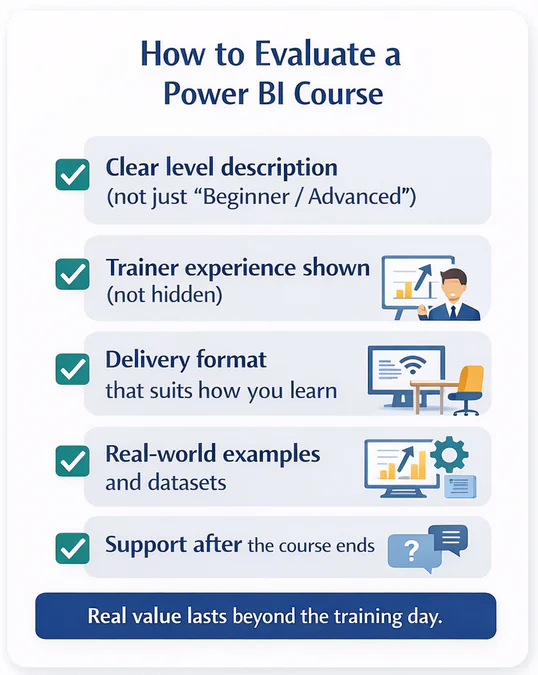
Course labels aren’t standardised. One provider’s “intermediate” course may be another’s “advanced”. If you need to learn DAX, make sure the course mentions it specifically, do not assume!
Look for:
-
Clear prerequisites
-
Specific tools and features being taught (not vague promises)
-
Examples of what attendees will be able to build afterwards
If the level description is ambiguous, that’s a warning sign.
2. Choose a delivery format that suits how you learn
Some people will learn Power BI best in a classroom setting, where questions can be answered immediately and problems can be worked through in the moment.
Others prefer live online sessions, especially when time, travel, or team logistics are factors.
There’s no right answer — but choosing the wrong format for your learning style often leads to disengagement.
3. Pay attention to who teaches the course
Strong Power BI courses usually highlight the trainer, not just the brand.
When researching, check:
-
Whether the trainer actively works with Power BI
-
If they have real-world reporting or modelling experience
-
Whether their background is explained clearly
Courses led by practitioners tend to focus more on practical problem-solving rather than surface-level features.
4. Look for support beyond the training day
Confidence is often highest during the course itself. Questions usually appear later, when applying Power BI to real datasets.
A course that includes post-course support, follow-up resources, or access to trainers often delivers far more long-term value.
Should You Prioritise PL-300 / Certification?
Certification can be useful – but only in the right context!
If your employer expects formal validation, or you work in an environment where certifications are required, then it makes sense to factor this in.
However, certification alone doesn’t guarantee practical competence.
Many capable Power BI professionals focus on building effective reports rather than passing the PL-300, while some certified users still struggle with real-world scenarios.
Rather than asking “Does this course include certification?”, a better question is:
“Will this course help me build better reports and make better decisions with data?”
How to Research Power BI Training Providers Properly
Beyond course content, there are a few signals worth paying attention to:
-
Independent reviews that describe outcomes, not just satisfaction
-
Clear explanations of what’s included (and what isn’t)
-
A professional, well-structured website that’s easy to navigate
A lack of transparency, unclear pricing, or vague descriptions often reflect poorly on the training itself.
Equally, if a course relies heavily on marketing language without explaining how skills are actually developed, it’s worth being cautious.
Classroom vs Live Online Power BI Training
Both formats can work well, depending on the learner.
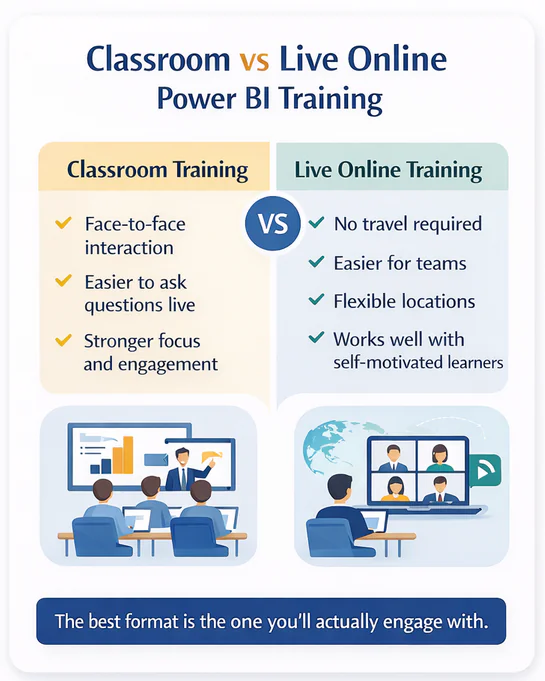
Classroom Power BI training tends to suit people who benefit from face-to-face discussion and guided problem-solving.
Live online training offers flexibility and is often more practical for distributed teams or busy schedules.
If you’re unsure which works best for you, many learners find in-person training more effective — particularly when tackling complex Power BI concepts for the first time.
What Is a Reasonable Price for Power BI Training in London?
Power BI course pricing varies widely.
Lower-cost options often limit class size, depth, or ongoing support.
Higher-priced courses may include certification, smaller groups, or extended access to trainers.
There’s no universal “correct” price, value depends on what’s included.
When comparing options, ask yourself:
-
What support do I get after the course?
-
How tailored is the training to real business scenarios?
-
Am I paying for learning, or for branding and credentials?
These questions usually clarify whether a course is good value or not.
Final Takeaway
The best Power BI course in London isn’t the one that ranks highest, it’s the one that fits your needs.
Before booking, be clear on:
-
Your starting point
-
How you prefer to learn
-
What you expect Power BI to enable you to do at work
Once those are clear, finding the right course becomes far simpler – and far more worthwhile.
- Facebook: https://www.facebook.com/profile.php?id=100066814899655
- X (Twitter): https://twitter.com/AcuityTraining
- LinkedIn: https://www.linkedin.com/company/acuity-training/